Introduction
I welcome everyone to my website called “The Romantic Period”. I will be writing about all, that is related to the, so called, Romantic Period in classical music which goes from the early nineteenth century to the first decade of the twentieth century, some say 1905. The first Romantic composer would be Beethoven, but he is classified as a classical composer as well. We call him a transition composer.
After Beethoven’s death the musical landscape of the Romanticism started to form with the beginning of the conservative school, led by the first Romantic composers such as Robert Schumann (1810-1856) and Felix Mendelssohn Bartholdy (1809-1847). These two were the “head of the house” of early German Romanticism and managed to educate and protect a lot of the more prominent composers and instrumentalists. Among the many musicians who were taken under Schumann’s and Mendelssohn’s wing notable examples are the very famous German composer and pianist Johannes Brahms (1833-1897) and the known violinist Joseph Joachim (1831-1907).
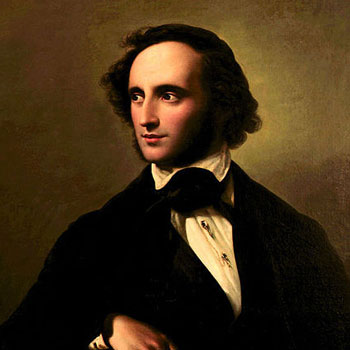
Known as Mendelssohn
Later on folks like Liszt and Wagner will create the New German School, which believed that the old musical forma that the conservatives used were obsolete and adopted more futuristic forms.
After the artists that I just named, who represent the middle Romantic Period, we get,of course, the late Romanticism, with Strauss and Scriabin, and later the Post-Romantic period. We have giants like Mahler or Rachmaninov.
Anyway…
On this website I will be sharing knowledge about these folks and funny or interesting anecdotes of the Romantic world. I don’t know how often I will be posting yet.
Transitional composers
Of course,with the many music periods that exist there are many transitional composers, leading the way to the future period.
Among the most famous transitional composers we find Domenico Scarlatti (1685-1757), collocated between the Baroque (1600-1750c.) and the Classical period (1750-1820c.). Scarlatti was born in Naples in 1685 and was, since childhood, a very religious person, as usual for the Baroque people. His father, Alessandro Scarlatti, as well as him a famous composer, conceded him the first performance opportunity at the age of 8. He is know as a transitional composer.
Where transitional composers start to become more important and recognised was between the Classical (1750-1810) and the Romantic period (1810-1905).
Beethoven, and the lesser known, Schubert are the most famous among them. Beethoven was,not only considered a master of the Classical style, but also the official starter of the Romanticism. His late orchestral works and his string quartets are remarkably romantic. We have of course the ninth symphony and his Große Fugue string quartet.
Schubert is, on the other hand, a more sober composer, but still of immense quality. During his short life he has composed more than 800 works of increasing quality. He is known for his lieder, a German form which precedes the modern song.
He composed over 200 songs and therefore entered and created the Classical canon of songs. We strictly tie songs with the German Romanticism, although he did write clearly classical pieces like his Trout quintet.
 The Romantic Period